



Research Directions
Photonic-electronic Hybrid Computing
By strategically integrating Silicon Photonics (SOl) and Thin-Film Lithium Niobate (LNOl) circuits with advanced electronic sub-systems, we create a co-designed hardware platform. This hybrid approach offloads massive, parallel matrix operations-the core of machine learning workloads-to energy-efficient photonic-electronic hybrid computing in memory engines that perform lossless multiply-accumulate operations within optical waveguides while maintaining high computational precision, paving the way for next-generation, low-latency AI acceleration.
Integrated Ferroelectric Photonic Memory
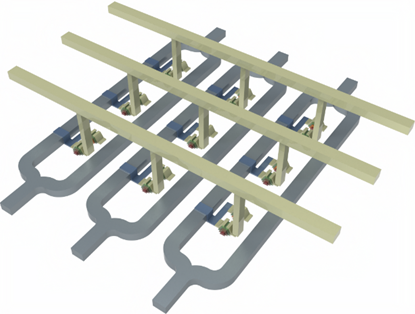
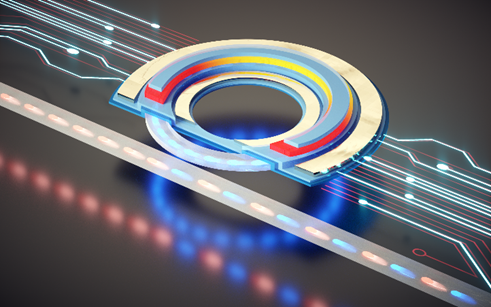
Our research addresses this challenge through a ferroelectric-based Pockels photonic memory platform that combines low-field-switchable ferroelectric memory devices with lithium-niobate photonic resonators. By coupling non-volatile ferroelectric polarization states to the Pockels effect in lithium niobate, we enable photonic devices to store and read memory states directly in the optical domain, rather than relying on repeated transfer to external memory subsystems. Built with CMOS-compatible, low-thermal-budget materials and designed for future heterogeneous integration, this platform supports multistate optical memory, programmable wavelength control, and scalable photonic in-memory computing architectures for reconfigurable and energy-efficient optoelectronic systems.
High-performance Photonic Interconnect
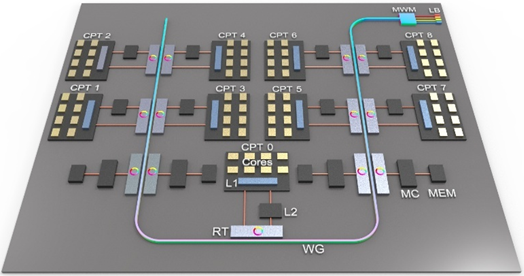
By strategically integrating Silicon Photonics (SOl) and Thin-Film Lithium Niobate (LNOl) circuits with advanced electronic sub-systems, we create a co-designed hardware platform. This hybrid approach offloads massive, parallel matrix operations-the core of machine learning workloads-to energy-efficient photonic-electronic hybrid computing in memory engines that perform lossless multiply-accumulate operations within optical waveguides while maintaining high computational precision, paving the way for next-generation, low-latency AI acceleration.
Hybrid Three-dimensional (3D) Integration
By vertically co-integrating Silicon Photonics (SOI), Thin-Film Lithium Niobate (LNOI), and advanced microelectronics, we bypass the parasitic losses of long planar interconnects. Our work focuses on die-to-die bonding, and dense electrical-photonic vias, creating ultra-compact, multi-layer architectures that deliver unprecedented packaging density, massive bandwidth, and ultra-low energy consumption for future computing and sensing systems.
Intelligent Sensing
Our research group focuses on intelligent integrated photonic sensors. We develop compact on-chip sensing systems based on silicon photonics and thin-film lithium niobate devices. Machine-learning methods are also introduced to improve signal interpretation and system adaptability.
Facilities